Tuesday, January 31, 2012

Doggie Flu Season

It’s that time of year… you feel horrible, your kids are coughing, everyone seems like they just have a really bad cold or even worse the flu. As your family is fighting this virus that is swirling through your house, don’t forget your dog can get the flu too.
People have asked me "what are the signs and how will I know my dog has the flu?" Basically, the symptoms are the same as humans:

Symptoms may include:
    Coughing
    Sneezing
    Fever
    Yellowish-green mucus
    Rapid/difficult breathing
    Loss of appetite
    Lethargy

Whose dog may get the flu?
Any dog may catch the flu but it tends to be prone to dogs that are exposed to multiple dogs.  Dog parks, playgroups, kennels and dog day cares.  Always keep your dog up to date with the kennel cough shot.  Most facilities are now recommending every 6 months your dog receives this shot.

How serious is the flu to my dog and can my dog die from the
flu? 
Well, like humans the flu and really make you feel miserable for a few days to a couple of weeks.  Most of the time, with a visit to the vet and some extra tender loving care to your pooch your dog will recover quickly.  Dogs that are not treated may have more complications. These secondary conditions, such as pneumonia could cause death if not treated. However, overall the death
rate from the flu in canines is quite low.

What do I do if I think my dog has the flu?
Call your vet immediately and make an appointment.  The vet will do a complete examination and will recommend your dog get plenty of water and sleep.  Your vet will also be taking precautions to prevent the flu from spreading into secondary conditions.  He may recommend some supplements, medication to prevent bacterial infections and intravenous fluids to maintain hydration.
Most importantly if your dog has the flu, please remember quiet time, a nice tummy rub and a good bowl of chicken noodle soup will make your
dog feel much better!

Thursday, January 26, 2012

Living with More Than One Dog

Living with more than one dog can be a rewarding experience. Dogs love the company of other dogs. Knowing how to prevent problems and teaching dogs how to share resources so they do not bully each other, or pester you, is pivotal to having a harmonious multi-dog home.
If you regularly let your dogs work it out among themselves, you give them a clear signal that you do not want to be involved when there is social conflict. If there is then an emergency, and you need to get your dogs’ attention, they will be less likely to look to you for guidance.
Dogs will frequently compete over resources. Resources include your attention, eye contact, affection, and praise; locations in the house and in the car; toys, balls, bones, food, and beds. A little preparedness on your part can go a long way toward preventing conflict. Your dogs should wait their turns for affection and food, respond to their names, and know how to sit, stay, look at you, and leave or drop objects.
  • Teach your dogs that all toys, affection, games, play, and petting come from you only when they are nice to each other. If they misbehave or bully each other for resources and your attention, give them a time-out or remove what triggered the behavior. Make sure the situation is managed so the problem does not reoccur.

  • Provide plenty of resources for your dogs so that there is little competition between them. If you have only one food bowl, dog toy, or dog bed, your dogs will be forced to take turns or fight over them.

  • Say your dogs’ names routinely so each dog can figure out who is being focused on. If other dogs get involved when you are focusing on an individual, turn your back on the intruders or look away from them.

  • Do not give your dogs attention for being nudgy, barking at you, jumping on you, or bullying each other. Don’t pet your dogs when they barricade you or push themselves on you. Teach your dogs impulse control, and reward polite manners.

  • All dogs should wait for treats and meals or have places to go when they eat so that they do not intrude on each other.


  • Dogs should wait or be taught to sit before they go outside. Please do not ask an older dog to sit; older dogs frequently have hip and knee problems, and sitting can be painful for them. Ask older dogs to wait or stay instead. The goal is not for your dogs to sit, but for them to not barge through doors when you open them. If you have a young dog who regularly hesitates when you ask him to sit, take him to a veterinarian.

  • When you pet one dog and another dog intrudes so that he becomes the center of attention, if you reward him you are rewarding that behavior. The dogs then compete for your attention, and one dog will inevitably be driven away. This does not set a good precedent for you as a leader.

  • If you are petting a dog and another dog barges in and pushes that dog away, ignore the dog who intruded by looking away or turning your back to him. Continue petting the other dog. If he begins to nudge or growl at the dog who is receiving attention from you, stand up and look away from both dogs. When the dog who growled or nudged his way in sees that his behavior did not work for him and loses interest, go back and pet the dog you had been giving attention to.

  • If dogs growl at each other over an object or a bone, remove it. If a dog has a toy or other object and another dog intimidates him by staring at him, interrupt the stare and direct that dog to another behavior. If one dog takes a toy or an object from another dog or makes that dog drop the object or leave the area, remove the item from the dog who took it and give it back to the dog who originally had it. You may have to do this multiple times, but your dogs will get a message from you: bullying behavior doesn’t work. You will notice a remarkable change in your dogs’ behaviors. The dog who may be regularly harassed or bullied will thank you, and there should be less conflict between the dogs in the future.

Wednesday, January 25, 2012

Hump Day Article - Mounting: An Embarrassing Problem

Below is a very good article written by a veterinarian, Dr. Lisa Radosta. I know so many Dog owners who experience this problem and I hope this article will help:


It’s a beautiful evening at your house. You’re having a lovely barbecue in the cool spring air, your dog is happily visiting with your guests, but there is one guest in particular who has become the recipient of your adolescent pup’s love — as is evidenced by the fact that he keeps wrapping his front paws around her leg and mounting it.

You pull him off of her and apologize repeatedly. Does he just like her? Is he trying to dominate her? Is he trying to show that he owns her? None of the above. In this case, he is anxious about his interaction with her and resorts to what is familiar and easy to displace that anxiety.

Generally, mounting doesn’t cause any harm to the dog or the recipient. But it is embarrassing, and owners want it to stop — and rightly so. Both females and males mount, even when spayed or neutered. Dogs may mount people, other animals, and inanimate objects. Dogs can also mount or stimulate mounting by other dogs due to medical diseases that affect estrogen and testosterone levels (e.g., sertoli cell tumors, granulosa cell tumors) or that affect the scent profile (e.g., anal sac, urinary tract, uterine or vaginal infections). Administration of certain medications can alter behavior as well.

People often incorrectly assume that mounting is due to a need to dominate a person or animal. What about the dog who mounts his stuffed toy or pillow? Is he trying to dominate that too? It doesn’t make sense does it? That is because mounting as we commonly see it in pet dogs doesn’t have anything to do with dominance.

Mounting can point to many different emotional states. Under most circumstances mounting is normal. It is a normal part of mating behavior and play. It is also used to establish rank between group members. At you may have already guessed, it can simply be an enjoyable way for an understimulated dog to entertain himself. Finally, dogs can also mount as a displacement behavior.

A displacement behavior is exhibited when a dog is anxious, uneasy, or overly neurochemically stimulated by a person, animal or situation. Ever twist your hair or bite your nails? If so, you are exhibiting displacement behaviors too!

Like any other behavior, mounting can persist if it is rewarded by the owner's attention (negative or positive). It can also be innately rewarding. The science of learning applies to all behaviors — if you reward a behavior, it will increase in frequency.

What should you do if your dog mounts? If she isn't causing any harm, don't do anything. If she is annoying other dogs with her behavior and the dogs are not correcting her appropriately by growling or snapping, you should intervene. Teach her to come to you when you call and sit. When you see that she is sidling up to a dog and getting ready to mount, call her over and ask her to sit for a yummy treat. Then distract her with play or obedience exercises.

If she frequently mounts in certain situations or mounts certain people, she is telling you that those situations make her uneasy or are just too much for her to handle (i.e., too stimulating). Introduce her to those situations with lots of come-sit interactions and lots of other kinetic things to do so that she doesn't engage in that behavior. Make sure that she knows how to get any attention from people so that she doesn’t engage in this behavior in the first place. Give her something else she can mount, like a large stuffed animal, pillow or blanket. Alternatively, you can engage her in another activity, like play.

If your dog has suddenly started mounting other dogs, people, or objects, or is suddenly being mounted by others, take your dog to your veterinarian for an examination and possibly labwork. She may have an underlying medical condition.

You can find more information about mounting at this link: Body Language Spotlight: Mounting

Friday, January 20, 2012

Does Music Actually Soothe Pets?


Pet anxiety can manifest itself in many different ways. We love our pets, so of course we worry. We don't want to see them upset or stressed out.

Some of you have said that your pets become upset when they are left home alone for any period of time. That's a common problem. Others have mentioned their dogs' anxiety or carsickness when traveling in the car. Some pets become very anxious when they are in unfamiliar surroundings. And some actually throw up or chew away areas of their hair and skin during thunderstorms, or when they hear loud noises like fireworks. When they are stressed, many dogs are likely to hide and not be found. Some dogs get manic and run away.

Some pet owners have tried creative ways to ease their pets' stress, like leaving the TV or radio on for "company" when their pets are home alone. But that could actually be doing more harm than good. Studies have suggested that TV and radio can actually CREATE stress for our pets because of the drastic changes in programming and the random mix of musical styles. The TV and radio certainly create "noise," but they don't necessarily create a relaxed environment.

Dog owners sometime ask,  "Does music soothe pets the same way it can relax people?" The answer is "yes" - but it depends on the music.

Music Eases Pet Anxiety - But Not Just ANY Music Will Do

Music is good for the soul. They say it calms the savage beast. And it turns out that's more than just an old wives' tale. It's a proven fact.

Classical harp music is used around the world to help alleviate stress and heal sickness in dogs, cats, chimpanzees and other animals. Even animal shelters are installing sound systems and using music to create a more serene environment. Studies show that dogs and cats prefer classical music. Cats will relax in front of the speakers when classical music is playing, and dogs will actually bark less - especially when listening to the music of Bach.

Our pets respond favorably to classical music under stress-inducing situations, often slipping into a very serene and peaceful state of mind after only a few minutes of listening. But all classical music will not have the same calming effect. For the music to soothe a pet, it must have a soothing dynamic from start to finish - which is not the case with most "off-the-shelf" classical music.

That's why I want to tell you about the
Music My Pet CD.

This remarkable "Classic Cuts" CD was developed for the specific purpose of calming our pets. It uses the sounds that have been proven to calm dogs, cats and other household pets, so it really works.
Music My Pet was created by the same folks that brought you Disney's award-winning Baby Einstein series for kids, so this is music at its very best.
I think this CD is amazing!

Acclaimed producer/composer/performer Tom Nazziola is the man behind the musical genius of Music My Pet . By researching the latest studies on pet anxiety, he identified the sounds, chords and harmonies that proved soothing to our pets (and to us). Then he used these elements to re-orchestrate popular classical music by Bach, Beethoven, Brahms and others. Nazziola gives each piece of music a soothing dynamic from beginning to end. The result is a calming collection of beautiful classical music that will help ease your pet's stress.

When your pets are left at home alone, this musical CD can provide them with a more comforting environment. Not only will it help calm your pets, it will also ease your troubled mind. When you must leave your pets home alone, this CD will create a serene atmosphere for them while you're gone.

But you won't just use it at home. One pet owner whose dog gets carsick on long road trips has had great results by playing the
Music My Pet CD in the car. Pets find it very soothing, and so will you!

Want to hear what the music sounds like? 
Click here to listen to a sample track from the CD.

The
Music My Pet CD can help your pets cope with nervousness, stress and separation anxiety, and provide the healthy relaxation they need. Give it a try. It could do your pets a world of good.

Wednesday, January 18, 2012

How to Stop Your Dog From Jumping

I don’t like it when dogs jump on me. I can’t tell you why it bothers me so much, it just does. Interestingly, nuisance jumping is a common complaint from owners as well.

Most often, dogs are jumping for attention. Dogs who are overly anxious, such as those with separation anxiety, may also jump even when the owner is ignoring them.

Don’t make jumping more than it is. It is not an effort to dominate you or lead your pack. First, domestic dogs don’t form packs, so you are not a pack member. Second, dogs generally don’t want to run the world. Nope, no visions of grandeur. They simply want attention from you. That is it, plain and simple. The dog is trying to get you to give her attention. If you are a dog, it’s natural to want to be up near the hands or face of someone who may pet you. Third, dogs don’t try to dominate each other by jumping up to lick each other’s faces.

Unfortunately, owners generally do pet dogs when they jump up. This reinforces (rewards) the behavior, making it more likely to occur again. To the dog, any type of attention can be considered reinforcement. This includes pushing her away and yelling at her. Through basic positive reinforcement (there’s the science of learning again), we have trained our dogs to jump on us starting in puppyhood. Once again, it is not the dog’s fault.

Take the following, common example: When first adopted, the puppy jumps on you. You bend down to pet her. While this is fine when the puppy is 10 pounds, it’s not nearly as enjoyable when she’s 100 pounds. Then, when the puppy gets a bit larger and is in adolescence, the jumping becomes annoying. You try different methods, such as ignoring her, kneeing her or yelling at her. She continues to jump. Making it even more difficult for your dog to learn what is appropriate, there are inconsistencies within the family regarding how they interact with the puppy. Some people pet her when she jumps up and some yell at her. Finally, there are invariably inconsistencies between what family members and visitors do.

This is very confusing to the puppy. She can’t be sure what type of behavior is appropriate. The scientific term for these types of interactions is variable reinforcement. Variable reinforcement means sometimes the pup is rewarded and sometimes she is not. Believe it or not, this kind of reinforcement is the most powerful kind you can apply to a behavior. You read that right. You are actually making the behavior stronger by sometimes punishing and sometimes reinforcing. What results is a very persistent jumper.

To understand variable reinforcement better, consider the example of a person at a casino. This person might leave the roulette table after losing 2 or 3 times, but will sit at a slot machine for eight hours. Why do they do that? Because the slot machine employs variable reinforcement. The slot machine delivers small rewards intermittently throughout the day. There are enough rewards, statistically, to keep the person playing all day. There's even the promise of a possible huge jackpot at some point during the day.

Teaching pups not to jump is pretty simple — ignore the pup when she is jumping and teach her an alternate way to get attention.

Follow these simple tips and your dog will be asking for attention politely in no time.

  1. Do not knee, kick, or yell at her when she jumps on you.
  2. Ask your puppy to sit for every bit of attention she gets. All of the time.
  3. If she’s jumping on you, walk away from her and completely ignore her. Don’t even make eye contact. When she stops jumping on you, ask her to sit. Then, reward her with petting, praise and/or a treat.
  4. When you praise your pup for sitting for attention, make sure to keep your praise calm and cool. It’s not fair to the pup if you get extremely excited praising her while asking her to stay under control.
  5. Like any other behavior, you will see the most improvement if everyone in your pup’s world follows the same plan.
  6. Until you can get your pup’s jumping under control, you can try distraction techniques like tossing small treats off to the side, or tossing a toy when you come through the front door.

Friday, January 13, 2012

Wagmore Quality Petcare, LLC: Does Your Pup Have Separation Anxiety?

Wagmore Quality Petcare, LLC: Does Your Pup Have Separation Anxiety?

Wagmore Quality Petcare, LLC: Humane Ways to Teach Your Dog to Walk Nicely on Leash

Wagmore Quality Petcare, LLC: Humane Ways to Teach Your Dog to Walk Nicely on Leash

Wagmore Quality Petcare, LLC: Panting – Normal or Not?

Wagmore Quality Petcare, LLC: Panting – Normal or Not?

Humane Ways to Teach Your Dog to Walk Nicely on Leash

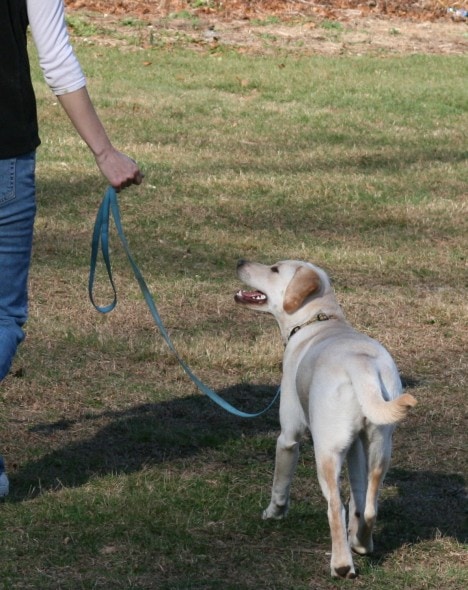
When a dog pulls excessively on leash, it is unpleasant for both the dog and the person walking him. Many people resort to yanking on their dogs, using pinch or choke collars, or stopping every few feet hoping for something to change. Using a choke chain or pinch collar may lessen pulling temporarily, but these collars are very unpleasant for your dog and can be physically damaging. Trying to force your dog to walk behind you can be just as unpleasant. However, there are many fun, motivating, and gentle ways to lessen your dog’s pulling. By following the below tips, your walks will improve with your dog and you will both enjoy walking together.

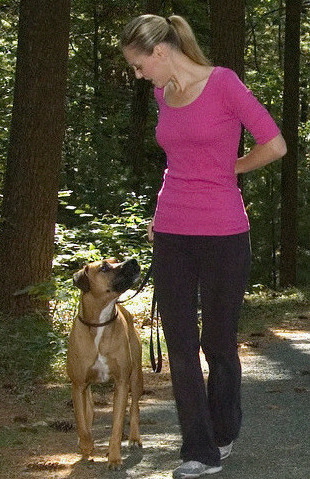
1) Reinforce and reward all attention your dog gives you. When your dog is attentive to you, he will look at you or in your direction. If you cannot get your dog’s attention while out on a walk, you will not be able to communicate with him. Start in a quiet location — indoors is okay. Make a high-pitched noise or sound that has intonation or inflection, such as a perky “Hey,” or make a clicking noise with your tongue (most dogs respond well to this). The moment your dog looks at you in response, pop an extra delicious treat in his mouth. Repeat this exercise until your dog quickly looks at you when he hears your cue. When taking the attention exercise outside, practice at times when it is relatively quiet and in locations that are not too busy or distracting.
You can also shape attention by simply praising and treating your dog every time he looks at you or glances in your direction while on a walk. Your dog will look at you and check in with you more frequently. If your dog obsesses over you looking for food, ignore him for a little while. Wait until he stops focusing on you or he looks at something else and becomes mildly distracted. Make the fun attention noise you’ve been shaping. The moment your dog looks at you, praise him and give him a mouth-watering treat. Your dog will begin to look at you when there are distractions outside. Keep rewarding your dog until he checks in with you regularly. Your dog will naturally start to look at you for guidance and direction.

2) Acknowledge and reward your dog for following you without physically forcing or pushing and pulling him to do so. Exaggerate your body language when you walk, turn, and stop. Give your dog positive verbal feedback and reward him for copying you. If you turn, and he turns with you, praise and treat him. When he stops after you do, tell him how great he is. Then cue his behaviors by labeling what you do on walks. For instance, when you stop at a curb, he will too. Tell him to “Wait” as he stands next to you. Then give him a treat. When you start walking again say, “Let’s go.” As you turn or change direction, make a little attention noise before you turn, and say “This way” — you get the idea! Treat him when he turns with you to follow. You are now labeling his behaviors so he can learn to take cues from you.

3) Make walking fun! Your dog’s walk is for his benefit. It is his time to de-stress and enjoy himself. People often are impatient when dogs stop to sniff on walks or when they stop to look at something. They pull or yank their dogs to follow them. Allow your dog to sniff on walks. He will enjoy his walks more and therefore, will be more responsive to you when you give him an instruction or want him to follow you. When your dog stops to look at something, let him. Then say “Let’s go” and praise him for continuing to walk with you.
If you have a dog who likes to chew, take balls or sticks on the walks with you. Let your dog chew or play with the toys, balls, or sticks while you walk together. Your dog will enjoy his walks and your company. He will be much more interested in you, and there will be less disconnect or conflict on the leash.

4) Speed up your walks and vary the pace. Dogs have four legs and a low center of gravity. They walk faster than most people run. Forcing a dog to walk behind you is uncomfortable and extremely unpleasant to him. It sets up a confrontation with your dog when there is no need for one. By quickening the pace of your walk, your dog will pull less and he will get more exercise. If your dog wants to walk quickly, pat your thigh and say “Quickly,” then run with him. Reward him for running with you. Slow down, and then praise and treat him for walking with you again. By allowing him to walk at a more normal pace for him, he will be more relaxed and more attentive to you.

5) Jerk less. Instead of yanking your dog or keeping the leash tight, maintain a relaxed leash. Dogs have an oppositional reflex, which means the more you push or pull against them, the more they will push or pull back in return. This is your dog’s automatic response, regardless of his age or breed. If your dog pulls you or steers you in a direction you do not want him to go in, instead of yanking or pulling back on him, lock your elbow and stiffen your arm, or simply stop for a moment. He will stop what he is doing and slow down or check in with you.

In summary, by praising and rewarding your dog for looking at you, turning with you, and stopping when you do, and by making walks fun and interesting for your dog, he will be more attentive and responsive to you. You’ll both be able to enjoy walks again.

Thursday, January 12, 2012

Panting – Normal or Not?

Dogs pant. They pant when they’re hot, they pant when they’re excited, they pant when they’re scared, and sometimes they seem to pant for no good reason at all. When a dog is panting more than expected, should an owner be concerned? The answer is "maybe."

Excessive panting can be a sign of a medical problem, including obesity, heart problems, diseases of the lung, laryngeal paralysis, canine cognitive dysfunction and other disorders that cause anxiety, steroid use, Cushing’s disease, and more. If your dog has begun panting at what appears to be inappropriate times, the first thing you should do is make an appointment with your veterinarian.

A Vets normal work-up for a dog that is panting a lot includes a history, physical exam, chest X-rays, a blood chemistry panel, complete blood cell count, urinalysis, fecal examination, and heartworm test if prevention and testing is not current. Depending on the findings, the Vet might also recommend an EKG, blood pressure testing, a laryngeal exam under light sedation, and additional testing for Cushing’s disease.

If a dog gets a clean bill of health but is still panting a lot, what might be going on?

Most dogs, especially those with thick coats, are really built for cold weather. Dogs just can’t dissipate heat as well as animals that can sweat. With any type of exercise, even a thin-coated boxer quickly turns into a pooped-out panter in the summertime. So, while you might feel that the temperature indoors or out is on the cool side, your dog could very well be thinking, "Who turned up the heat?" Pay attention to your dog’s behavior. If he is seeking out cool places in the house or yard and doesn’t pant when he finds one, you’ve probably found your answer.

This type of heat intolerance becomes even more profound as dogs age. Many an elderly dog that seems to be on his last legs during the summer months, bounces back when winter arrives.

In short, if your dog is panting a lot, get him checked out by your vet, but don’t panic. As a friend recently put it, the dog may simply have "excessive panting syndrome." You won’t find that diagnosis in any veterinary textbook, but it seems to fit the bill in many cases.

Wednesday, January 11, 2012

Does Your Pup Have Separation Anxiety?

Separation anxiety is a disorder of hyper attachment, where a physiologic panic response is paired with the owner’s departure.
It occurs in about 20 percent of dogs in the United States. There is no specific breed predilection for this disease, although some breeds (Weimeraners) have been indicated in one study.

Separation anxiety is more common in single owner households. It occurs with the same frequency in households with male or female owners, multiple dogs or only dogs, and in families that spoil their dogs and ones that do not. Dogs who have been through an animal shelter are more likely to have this disorder. While it hasn't been studied specifically, I suspect that it is not the shelter itself that causes the disorder, but rather the fact that the dog has been rehomed.

Dogs are social creatures, which causes them to bond closely to us. This is part of why we love them so much. When they are suddenly moved to a new home, they experience stress; they attach to the person with whom they are most comfortable or spend the most time. Add to that the dog’s keen ability to read their environment. Because of this, they pair the stimuli (cues) that precede the owner’s departure with the owner’s absence. Then, these cues — such as picking up keys or putting on shoes — become associated with the physiologic panic response.

This is called classical conditioning and is outside of the dog’s control. What results is barking, crying, urination, defecation, destruction, and other signs of distress when the owner leaves. Some dogs can even be aggressive, trying to block the owner as they try to leave the house.

Early signs of separation anxiety in your pup, such as following you everywhere, should spur you to spring into action. Because a physiologic response is at the root of the disorder, prevention focuses on keeping the pup from having that emotional response and pairing it with your departure cues. While obedience training is helpful in many aspects of your dog’s life, separation anxiety is not a problem of obedience, so it does not respond to obedience training.

To prevent your pup from developing separation anxiety, follow these simple steps.
  1. Do not pay attention to your pup when he follows you.
     
  2. Ask your pup to sit before you interact with him. If he doesn’t know how to sit yet, lure him with a treat. This sets up a predictable, structured relationship between you and your pup and helps him to understand how to get attention from you.
     
  3. Spread the responsibilities for care of the pup to different family members.
     
  4. Teach your pup to lie down and stay as you move around the house. This will help him to be more secure with your absence.
     
  5. Hide all departure cues from your pup so that he can’t begin to associate those with your departure.
     
  6. Keep your pup from having a full-blown emotional response. This means that he should not be following you to the door when you go to leave. Instead put him in his crate with something really fun to do, well before you get ready to leave.
     
  7. Associate your departure with something wonderful, like a rare treat that he only gets at that time of day.
     
  8. Confine your dog in his crate for 10 to 15 minutes once a day when you are home. Crate time should be fun, not punishment. This way, the crate will not be paired with your departure.

Tuesday, January 10, 2012

5 Ways to Keep Pets Healthy

Preventive Care Can Make a Difference

Labrador retriever
Our pets tend to give us the silent treatment when it comes to their health. Because they are unable to tell us when they have an ache or a pain, it’s up to us to look for tell-tale signs that may indicate an issue.
Simple routine care measures can help maintain your companion’s well-being and help to promote a long and healthy life.

1. Bi-Annual Exams

Dr. Cori Gross, a veterinarian in Seattle, Wash., says one of the most important things you can do for your pet is to make sure he gets routine veterinary examinations. “It’s all about taking preventative measures,” she explains. “You want to make sure you catch any potential problems early; that way it’s less expensive to care for your pets in the long run.”
During a bi-annual exam, your veterinarian will conduct a complete physical exam to check your pet’s condition from nose to tail. They will evaluate everything from your pet’s heart and breathing to their ears, mouth and skin during this process. In addition to the examination, your veterinarian may recommend the following:
Cat is examined by a veterinarian
  • A blood panel: This is a group of tests that help monitor liver and kidney function, red and white cell blood counts, and can help identify abnormalities that your pet may not be telling you about! Your veterinarian may suggest that seniors, pets over the age of 7, be tested bi-annually.
  • A fecal test: This simple test checks pet’s stool for parasite eggs and/or other organisms that can be shed during irregular intervals; puppies usually are tested more frequently than adult dogs.
  • Additional tests: May be recommended including x-rays, an EKG, blood pressure measurement or others. Your veterinarian will identify the most important tests for your pet based on their individual history and needs.

2. Dental Health

Dental care plays a big role in maintaining a pet’s overall health. According to the American Veterinary Dental Society, it’s estimated that more than 80% of cats and dogs over the age of three show signs of oral disease. This includes everything from gum disease to oral melanoma (cancer).
Research indicates that proper dental health can extend the life of your pet by two to five years.
While the need for professional dental cleanings will vary from pet to pet based on your pet’s age and oral condition; there are a few simple ways to promote a healthy mouth in the meantime:
Dog has teeth brushed
  • Brush at home: Get your pet into a daily or weekly habit of having his teeth brushed at home. Use a finger brush or a pet toothbrush and pet toothpaste (never use human toothpaste; the sweetener can be toxic to pets). Once your pet gets into the routine, this task will become easier and can potentially extend the time between professional dental cleanings.
  • Greenies®: According to the company, this edible dental chew (shaped like a toothbrush) can reduce tartar up to 69% and tartar buildup by 10.5% if eaten once a day. Ask your veterinarian about the appropriate size Greenie for your pet and remember that this treat adds to the total calorie intake your pet consumes during the day.
  • Annual oral exam: Having your pet’s mouth examined once (or twice) a year during a routine checkup can help identify potential oral problems before they become serious.
  • Bad breath: You may think that a stinky mouth is normal when it comes to your pet, but be careful: foul-smelling breath can indicate a serious problem either in your pet’s mouth or a digestive issue. Schedule an examination if your pet develops noticeably smelly breath.

3. Healthy Diet

Dog stares at food bowl
Your pet’s dietary needs change over the course of his life, from birth to adolescence to adulthood and then to old age. A life stage diet is one that is tailored to meet the different nutritional needs as your pet ages.
Dogs’ and cats’ nutritional requirements are quite different from one another. It’s always wise to discuss the best diet for your pet with your veterinarian at each stage of your pet’s life. Check the food packaging for an AAFCO statement which will let you know if the product has been specifically tested and labeled to be safe, effective and designated for a particular life stage.
Portion control is important to maintain. When reading the label on your pet’s food, follow the recommendation for your pet’s ideal weight, not his current weight as some pets may require more or less than the labeled amount to maintain a healthy weight.
While some dogs may require special diets due to medical issues, the average small or medium breed dog should eat food containing:
  • High-quality, animal-based protein for muscle maintenance.
  • Fiber for a healthy digestive tract.
  • Essential vitamins and minerals for the immune system.
  • Vitamin-rich fish oils for a healthy coat and skin and for overall health.
  • Healthy grains for energy.
Cat food bowl
Cats are strict meat eaters, or carnivores, so the food should contain a high level of easily digestible protein. Fat is also important for needed calories. If you want, you can blend dry cat food with canned food.
Adult cat food should also contain:
  • Vitamin A, from liver, kidney and other organ meats, and niacin for healthy growth.
  • Essential fatty acids for healthy skin and fur.
  • Taurine for healthy eyes and heart muscle.
Your senior pet may develop age-related health issues in the last year or so of his life. There are different food and supplements to address different problems. Your veterinarian can help guide you to make sure your pet has a quality of life as long as possible.

4. Daily Exercise

According to a Purina study, 60 percent of pets are overweight.
Diabetes, heart and lung diseases, bone and joint diseases, skin conditions and different types of cancer are more common in overweight animals, as is a shorter life expectancy. Many of these health problems can be alleviated with regular exercise and proper dietary management.
If your veterinarian approves of daily exercise for your pet, try some of these easy approaches:
Chocolate Lab runs with owner
  • Daily walks: Take your dog for brisk walks of at least 20 minutes twice a day. Some cats can be trained to walk on a leash as well, so find a good harness and don’t give up after a few attempts.
  • 15-minute training routine: Not only can dog training can curb bad behavior and strengthen your relationship with your pet, the mental stimulation is exhausting for your companion. Consider taking dogs outdoors for an invigorating session up and down your driveway, in the backyard or on your neighborhood sidewalk.
  • Indoor activities: Your pet can get as much exercise in an indoor setting as those who have outdoor space to run. Interactive toys such as motion-activated mice, balls and others not only mentally stimulate cats and dogs but also encourage exercise.Scratching posts, towers and dens, and carpeted cat trees are perfect for climbing, playing and hiding.
  • Dog-walking services: Available by popular demand, this may be a reliable solution for those with puppies and those working long hours or traveling. Be sure your pet walker is bonded, insured and licensed, and some businesses offer dog training classes and pet boarding as well.
  • Doggie daycare: Pet facilities provide exercise and playtime away from home. Imagine a Gymboree for pets. While you’re working, your furry companion is chasing balls and playing tug-a-war with pup pals under the supervision of an experienced staff.

5. Parasite Prevention and Management

Labrador retriever sits in a field
Keeping up with parasite control is instrumental in maintaining the health of our furry friends. Fleas, ticks, heartworms and intestinal parasites can cause everything from discomfort to life-threatening illnesses in pets. For example, fleas can live for a couple of months and females can lay up to 2,000 eggs in their lifetime.
Pets are commonly allergic to fleas and can develop significant skin irritation from scratching. Ticks can pass dangerous infectious diseases when they bite. For both, prevention is the best medicine. There are a number of safe, effective monthly products that you can use to keep these pests from hurting your pet.
Heartworm disease is passed by mosquito bites and is fatal if not treated. Both cats and dogs are susceptible and there is no treatment for affected cats. However, there are several medication options that are safe and are completely effective in preventing this disease.
Finally, intestinal parasites can be a problem at any stage of a pet’s life. Routine fecal examinations and deworming treatments can keep serious medical problems to a minimum.
Consult with your veterinarian to determine the best method and products for your pet.

Monday, January 9, 2012

Signs of a Pet’s Allergic Reaction to Flea Medication

Many pets are allergic to over-the-counter flea drops, so it’s important to know the signs of an allergic reaction or intolerance to flea and tick medications.
It can take anywhere from a 24 hours to 72 hours for all symptoms to manifest. Mild symptoms tend to appear within a few hours and then resolve within 72 hours. More severe reactions can last for a longer period of time.
Symptoms of an adverse reaction to flea drops include:
  • Salivating
  • Panting
  • Vomiting
  • Diarrhea
  • Tremors or seizures
  • Ear twitching
  • Leg flicking
  • Hives
  • Swelling, often involving the face or paws
  • Refusal to eat or drink
  • Depression and lethargy
  • Difficulty walking
Some pets may experience a very mild reaction with leg flicking and a slight lethargy. Other pets may experience a more severe reaction. Whatever the case, immediate veterinary treatment is required. Your vet will administer an antihistimine medication to reverse the allergic reaction, in addition to providing IV fluids and other supportive measures and medications to help treat the pet’s symptoms.
If your pet is experiencing mild symptoms like leg flicking or mild lethargy, it’s typically best to wash off the flea medication using a dish soap (always use dish soap, as this cuts through the oils and completely removes the medication.) Rinse the pet thoroughly.
If you’re attempting to wash a cat, it’s best to wear gloves and several layers of long sleeves to protect your hands and arms. It will not be a pleasant experience, but it’s vital to remove the medication to stop your pet’s condition from worsening.
If your pet is symptomatic — vomiting, seizuring, diarrhea, difficulty breathing, swelling, hives or any other serious symptoms — do not attempt to wash off the medication. Bring your pet to the veterinary clinic immediately (call while you’re en route to notify the staff so they can prepare for your pet’s arrival). The pet will need to be stabilized before the medication is washed off.
Notably, salivation can be a result of a cat licking fur that had the medication on it. If this is the case, salivation will occur for a few minutes and it should quickly resolve. Offering milk or tuna water can help clear the taste from the pet’s mouth.
Also, it’s important to prevent cats from grooming other cats who have been medicated.

Other Tips for Administering Flea Medications to a Cat or Dog

Always keep the package and store receipt for your flea medications. Firstly, if your pet experiences an allergic reaction and requires treatment, the veterinarian will need to know how much medication the pet received and he or she will need to know the precise medication type.
In addition, the manufacturer of the flea drops will typically reimburse you for some or all of the costs incurred by treating the pet’s reaction. But you will need to have your receipt and the medication package.
Also, administer flea medications first thing in the morning on a weekday, when you’re going to be around to observe the animal for the entire day. You want to administer the flea drops at a time when the veterinary clinic is open; that way, if a reaction occurs, you can take your pet in for immediate treatment. This will help you to avoid costly ER bills.
Pet owners should also be sure to follow the directions for applying the medication. Dogs will receive a stripe of medication down their spine, whereas for cats, the medication must be applied to the base of the skull, where they can’t lick it while grooming.

Friday, January 6, 2012

Top Ten Resolutions for Your Pet


New Year, New Start


Get organized. Check. Get a better job. Check. Lose weight. Check that one twice. This New Year isn’t unlike any other -- you've probably made resolutions that you'll struggle to keep after the first week. Make a real difference in 2012 and forge a pact with your pet. These resolutions will help keep your pet happy, healthy and safe throughout the year. And well, what's more important than that?
#10 Pet-proof Your Home
As you may already know, pets get into anything and everything! Keep poisons and other dangerous items in secure places, preferably in a locked cabinet or in a room that is out of the animal's reach.
#9 Get Your Pet ID'd
Whether it is a tag or a microchip, identifying your pet and your contact information will help your chances of having your pet returned should it become lost -- especially in the case of lost dogs and cats. Just remember to keep the contact information current!
#8 Socialize Your Pet
Don't worry; you don't have to create a Facebook profile for them. But like children, your pet can become destructive and unmanageable when she is not given enough attention or is not allowed to socialize with other animals of her kind. Obedience/training courses are just what your pet needs to learn some manners. And remember, it's never too late to train an animal.
#7 Groom Your Pet
There is nothing worse than a stinky pet. Stay on top of her grooming routine -- bathe her, brush her coat, and clip her nails. All these things will make her the envy of your block. And if you haven't noticed yet, your pet is usually happier when she is clean and pretty.
#6 Have Your Pet Spayed or Neutered
Of course we all know spaying (and neutering) helps decrease the population of strays, but did you know many veterinarians believe it can benefit the animal's health too? Among the health benefits: a decrease in testicular cancer, prostate problems, urine marking and inter-dog (or inter-cat) aggression for males, and a decrease in mammary cancer, uterine cancer, and ovarian cancer for females.
#5 Use Preventives
Why worry about heartworms, fleas and other pesky parasites? Preventives are your pet's best line of defense against parasites and the deadly diseases they cause. Also, consult your veterinarian. Year-round use may be needed in warmer regions.
#4 Create a Maintenance Checklist
Maintenance is perhaps the most dreaded of all pet resolutions. Perhaps it's the awful smells or all the cleaning involved. Whatever the reason, developing proper maintenance habits (e.g., emptying the litter box, cleaning the cage, changing the newspaper clippings) will create a clean and pleasant environment for your pet. Also, poor sanitation can lead to behavior and health issues.
#3 Customize Your Pet's Diet
Diets should be suited to the animal's age and size. When kept at her ideal body weight, your pet can live a longer, healthier life. She is also at a lower risk of heart disease, joint problems, and various other conditions associated with poor health.
#2 Exercise With Your Pet More
Need an exercise partner? Look no further. Some dogs are satisfied with a walk around the neighborhood once a day, while others require additional exercise time. Take her to a park, to the beach or to your backyard, just make sure you have fun, too! Oh, and don't forget about your other pet(s). Just because she isn't a dog, doesn't mean she doesn't need exercise. (We're looking at you, Kitty!)
#1 Don't Postpone the Annual Checkup
Not only will waiting until your pet is ill lead to unnecessary suffering, complications may arise and this will make the animal's course of treatment more expensive. Keep your vet bills in check and visit the white-coated professional as regularly as possible.